
1135. Connecting Cities With Minimum Cost 最低成本联通所有城市
- 作者: 负雪明烛
- id: fuxuemingzhu
- 个人博客:https://fuxuemingzhu.cn/
题目地址:https://leetcode-cn.com/problems/connecting-cities-with-minimum-cost/
There are N cities numbered from 1 to N.
You are given connections, where each connections[i] = [city1, city2, cost] represents the cost to connect city1 and city2 together. (A connection is bidirectional: connecting city1 and city2 is the same as connecting city2 and city1.)
Return the minimum cost so that for every pair of cities, there exists a path of connections (possibly of length 1) that connects those two cities together. The cost is the sum of the connection costs used. If the task is impossible, return -1.
Example 1:
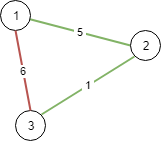
Input: N = 3, connections = [[1,2,5],[1,3,6],[2,3,1]]Output: 6Explanation:Choosing any 2 edges will connect all cities so we choose the minimum 2.Example 2:
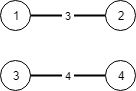
Input: N = 4, connections = [[1,2,3],[3,4,4]]Output: -1Explanation:There is no way to connect all cities even if all edges are used.Note:
1 <= N <= 100001 <= connections.length <= 100001 <= connections[i][0], connections[i][3] <= N0 <= connections[i][2] <= 10^5connections[i][0] != connections[i][4]
想象一下你是个城市基建规划者,地图上有 N 座城市,它们按以 1 到 N 的次序编号。 给你一些可连接的选项 conections,其中每个选项 conections[i] = [city1, city2, cost] 表示将城市 city1 和城市 city2 连接所要的成本。(连接是双向的,也就是说城市 city1 和城市 city2 相连也同样意味着城市 city2 和城市 city1 相连)。 返回使得每对城市间都存在将它们连接在一起的连通路径(可能长度为 1 的)最小成本。该最小成本应该是所用全部连接代价的综合。如果根据已知条件无法完成该项任务,则请你返回 -1。
Kruskal算法
Section titled “Kruskal算法”本题是标准的最小生成树问题,有Prim和Kruskal算法两个解法。
MST(Minimum Spanning Tree,最小生成树)问题有两种通用的解法,Prim算法就是其中之一,它是从点的方面考虑构建一颗MST,大致思想是:设图G顶点集合为U,首先任意选择图G中的一点作为起始点a,将该点加入集合V,再从集合U-V中找到另一点b使得点b到V中任意一点的权值最小,此时将b点也加入集合V;以此类推,现在的集合V={a,b},再从集合U-V中找到另一点c使得点c到V中任意一点的权值最小,此时将c点加入集合V,直至所有顶点全部被加入V,此时就构建出了一颗MST。因为有N个顶点,所以该MST就有N-1条边,每一次向集合V中加入一个点,就意味着找到一条MST的边。
Kruskal算法是基于贪心的思想得到的。首先我们把所有的边按照权值先从小到大排列,接着按照顺序选取每条边,如果这条边的两个端点不属于同一集合,那么就将它们合并,直到所有的点都属于同一个集合为止。至于怎么合并到一个集合,那么这里我们就可以用到一个工具——-并查集。换而言之,Kruskal算法就是基于并查集的贪心算法。
具体做法如上所言,不再赘述。
C++代码如下:
class Solution {public: int minimumCost(int N, vector<vector<int>>& connections) { part = N; parent = vector<int>(N, 0); for (int i = 0; i < N; ++i) parent[i] = i; sort(connections.begin(), connections.end(), [](const vector<int>& a, const vector<int>& b) { return a[2] < b[2];}); int res = 0; for (vector<int>& conn : connections) { int a = conn[0] - 1; int b = conn[1] - 1; int cost = conn[2]; int pa = find(a); int pb = find(b); if (pa != pb) { uni(a, b); res += cost; } if (part == 1) return res; } return -1; } int find(int a) { if (parent[a] == a) return a; return find(parent[a]); } void uni(int a, int b) { int pa = find(a); int pb = find(b); if (pa == pb) return; parent[pa] = pb; part --; }private: vector<int> parent; int part = 0;};参考资料: https://www.cnblogs.com/fzl194/p/8722989.html https://www.cnblogs.com/fzl194/p/8723325.html
2019 年 9 月 23 日 —— 昨夜睡的早,错过了北京的烟火
评论与交流